

Real estate comps hold the key to accurately pricing your home, yet many sellers struggle to find and interpret them. Comparable properties provide an evidence-based foundation for determining fair market value and help you avoid overpricing or leaving money on the table. Properties sold in the last 3-6 months are significant for accurate comparisons. Optimal comps are no further than one mile from your property. In this piece, we walk you through five practical methods to find reliable home comps and estimate your property's value with confidence.
Key Takeaways
Understanding how to find accurate real estate comps empowers you to make informed pricing decisions and avoid costly mistakes when buying or selling your home.
• Focus on recent sales within 3-6 months and one mile radius - Older comps don't reflect current market conditions, and distant properties may have different neighborhood dynamics affecting value.
• Combine multiple methods for maximum accuracy - Online platforms provide quick estimates, but MLS data through agents offers the most comprehensive and timely information for precise valuations.
• Match key property characteristics carefully - Square footage, bedrooms, bathrooms, age, and condition matter more than simple price comparisons when identifying true comparable properties.
• Understand accuracy limitations of automated tools - Online estimates can miss by 7%+ for off-market homes, potentially meaning $28,000+ errors on a $400,000 property due to inability to assess condition and unique features.
• Make proper adjustments for property differences - Account for renovations, lot size variations, and special features when comparing sold properties to ensure your valuation reflects your home's actual market position.
The most successful home valuations combine the speed of digital tools with the expertise of real estate professionals, giving you both quick insights and accurate market analysis for confident decision-making.
What Are Real Estate Comps?
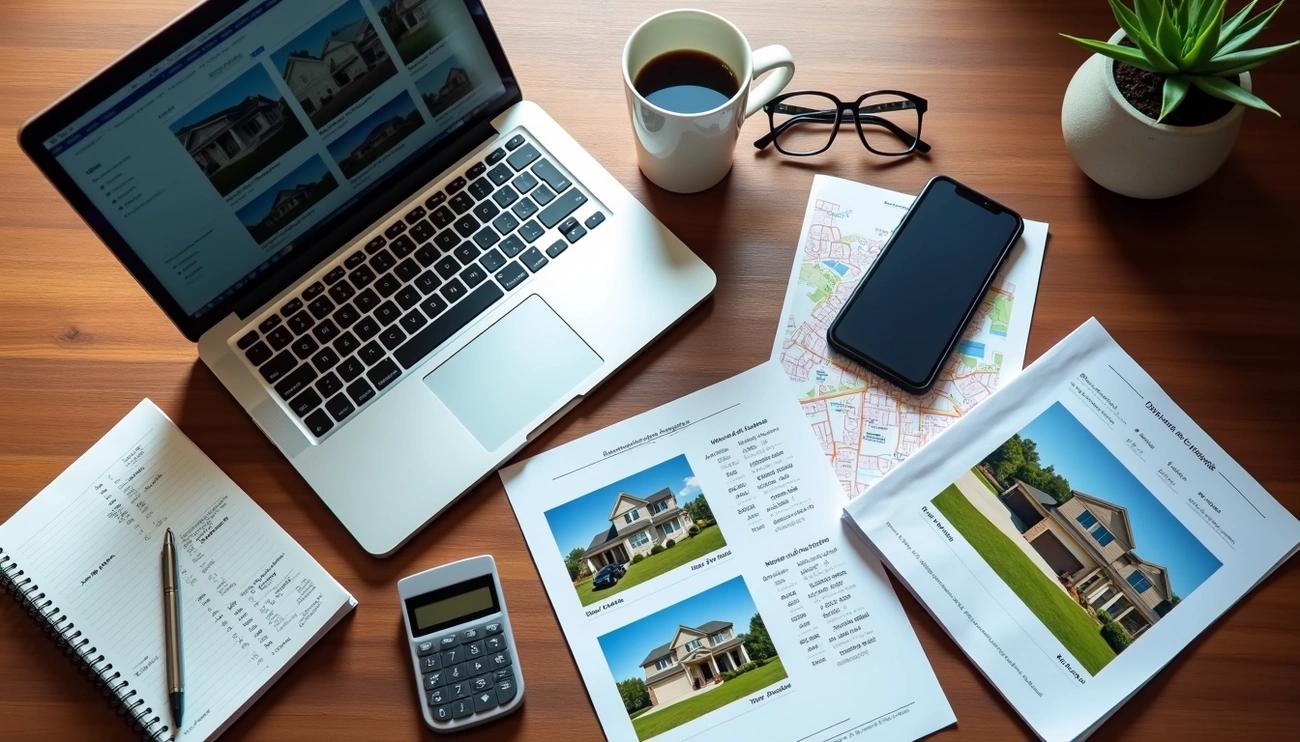
 Example of comparable homes used to estimate property value through real estate comps.
(https://www.rocketmortgage.com/learn/real-estate-comps)
Image Source: HAR.com
Comparable properties, commonly known as comps in real estate, are similar homes in your area that have recently sold and share key characteristics with the property you're evaluating. Sellers use these comparables to determine an appropriate listing price. Buyers rely on them to decide how much to offer on a home.
What qualifies as a true comparable goes beyond simple price matching. Real estate comps provide an evidence-based measure by analyzing properties that mirror your home's essential attributes. You're essentially looking for homes that create an apples-to-apples comparison when you search for comps in your area. This allows you to gage where your property stands in the current market.
What Makes a Property Comparable
Real estate comps aren't just about finding houses with similar prices. A detailed analysis thinks about multiple critical factors that influence property value:
- Location and neighborhood features that affect desirability and market need
- Square footage and lot size as primary value determinators
- Number of bedrooms and bathrooms matching your home's layout
- Age and overall condition of the structure and systems
- Recent renovations or upgrades that add market value
- Special features like pools or waterfront access
Square footage can substantially affect home value. This makes size matching essential when pulling comps. Lot size variations require careful attention likewise. You need to account for this difference when determining value if one house sits on two acres while another sits on 10 acres.
Timing and Distance Parameters
Your best approach involves finding homes that have sold within the last 6 months. Market conditions move faster, and older comparables can mislead your valuation efforts. Properties sold beyond this timeframe may reflect different market dynamics, interest rates, or seasonal variations that no longer apply.
Distance matters just as much as timing. Optimal comps typically fall no further than one mile from your property. The exact radius depends on whether you're in a rural, suburban, or urban setting. Dense urban neighborhoods might require tighter geographic boundaries. Rural areas may need to expand the search radius due to fewer available sales.
How Comps Differ from Other Valuation Methods
The difference between comparative market analysis and formal appraisals helps clarify how real estate comps fit into the valuation process. A comparative market analysis (CMA) provides an estimated price for your home by comparing it to similar homes that have recently sold in the area. Real estate agents typically prepare CMAs using databases like the Multiple Listing Service (MLS), which offers detailed property information.
A formal appraisal establishes the property's official value for lending purposes, unlike a CMA. Appraisers must think about a minimum of three comparables when conducting their sales comparison approach. This requirement ensures sufficient data points for accurate valuation.
Critical Matching Criteria
Property age plays a substantial role in valuation accuracy. New homes tend to carry higher values. A home built in 1980 and one built in 2015 may not have similar values despite featuring the same number of bathrooms and bedrooms. Factor in the condition of all parts of the homes you're comparing when running comps.
Many homeowners now use AI-powered seller reports to analyze comparable sales and estimate their home's value. These tools can quickly process multiple data points and identify relevant comparables. Understanding the underlying principles remains valuable for interpreting results though.
Finding the Right Number of Comps
Professional appraisers and analysts recognize that a minimum of three comparables must be considered in the sales comparison approach. This baseline ensures you're not basing your valuation on a single outlier or anomalous sale. More comparables generally provide better accuracy, especially when properties in your area show substantial variation in features or condition.
Real estate comps are the foundations for pricing decisions across the housing market. You position yourself to make informed decisions about your home's value by understanding what makes properties truly comparable and which factors just need the closest matching.
Method 1: Use Free Online Real Estate Platforms to Find Comps
Online real estate platforms give you immediate access to sold properties in your neighborhood. They make the most available starting point to find home comps. These websites combine sales data from various sources and let you search and compare properties without professional help.
Popular Platforms for Finding Home Comps
Zillow, Realtor.com, and Redfin all show sold property data that proves great if you don't have access to the multiple listing service. Each platform offers unique features that can improve your comp research.
Redfin uses complete MLS data on sold homes, which strengthens the accuracy of its tools. Search by address on Redfin and you can see public sale information, including the last sold price. Scroll down on the listing page to reveal nearby sold homes. Click "View More Recently Sold Homes" and a full map of recent sales displays.
Zillow gives a range of values for an estimated sales price and publishes the error rate for a given municipality. A two-bedroom, two-bathroom home in suburban Fort Lauderdale, Florida, with a Zestimate of $153,306 also notes that the home will likely sell for between $146,000 and $161,000. Redfin shows you the comps it used to reach its final number. This makes it possible for someone who knows the home to realize whether the comps were remodeled while the subject home was not.
Expand your search to more advanced sites like Homesnap if you can't find what you're looking for on tools like Zillow and Realtor.com. Professionals or investors who want deeper data insights often use paid tools like CoreLogic or RPR (Realtors Property Resource). Investing in these tools might be worth the cost if you're preparing to become an investor and plan to buy and sell more properties later. But they often aren't worth it for casual buyers and sellers who need to make single real estate transactions.
How to Search for Comparable Properties
Start your search by changing the filter from "For Sale" to "Sold". This simple adjustment moves your view from active listings to actual sale prices, which give far more accurate value indicators than asking prices.
Set the timeline to filter for sales in the last 3 to 6 months. Data from last year becomes useless in a moving market. Only look at off-market homes that sold within this timeframe, as these will give you the most accurate comparisons.
Filter listings by location, size, and features to identify similar homes. Only look at homes with the same bed/bath count and within 200-300 square feet of your size. Use filters to narrow results by property details such as square footage, lot size, year built, and HOA fees to match your home. Think about amenities like waterfront views or recent upgrades when refining your search.
Click through the photos for a visual check. Does that sold home have quartz countertops while yours has laminate? If so, you'll need to deduct value from your home when making comparisons. This approach gives a strong starting point to understand fair market value, though it may not fully account for conditions or renovations.
Filtering and Analyzing Comp Data
Sale prices offer the most accurate reports on what homes are selling for. Understanding what sellers list them for originally gives additional context. See how much buyers negotiate on average, what the difference between the listing and sale price is, and how long homes stay on the market.
You may decide to keep a spreadsheet of comparable properties with this information. You can then add new comps and remove less relevant ones (those with older sale dates or different features) as your dataset grows. The downside is that it takes manual math. You have to create your own spreadsheet and adjust for every difference such as pool, garage, or view yourself.
Many homeowners now use AI-powered seller reports to analyze comparable sales and estimate their home's value. These tools can process multiple properties faster, though understanding the manual analysis process helps you interpret automated results better.
Understanding Accuracy Limitations
Online home value estimates cannot replace the accuracy of professional home value estimators. Zillow reveals that it has a median error rate of 4.5%. As for its competitor Redfin, the error rate stands lower at 1.84% for on-market homes.
AVMs perform surprisingly well when a home is listed for sale. Zillow's median error rate drops to just 1.83%-1.94%, while Redfin achieves 1.98%. For off-market properties, which describes your home right now if you're just curious about its value, the median error rate skyrockets. Zillow's accuracy drops to 7.06%-7.5%, while Redfin's plummets to 7.66%-7.72%.
A 7% median error translates to ±$28,000 or more on a $400,000 home. Note that this is the median, meaning half of all estimates miss by even more than that. For a $600,000 property, you're looking at potential discrepancies exceeding $40,000.
Online home value estimators rely on several resources to draw their estimates. Some refer to the multiple listing services, while others have agreements with the services. This agreement is a limiting factor that doesn't allow full access to the MLS data. As a result, online home value estimates tend to lack accuracy due to the limited availability of data.
Every algorithm must assume your home is in average condition. Your newly renovated kitchen with custom cabinetry appears average to the system. Your finished basement adding 600 square feet registers as average. Your brand-new HVAC system shows up as average. Algorithms understand neighborhoods but don't deal very well with subtleties. Two similar homes, one on a quiet cul-de-sac and another backing a busy road, appear the same value to an algorithm but differ vastly to buyers.
AVMs depend on historical sales data, so they lag behind current conditions. This lag can render estimates nearly useless in faster-moving markets. For custom homes, luxury properties, or anything unique, AVMs often fail since there simply aren't comparable sales to analyze.
Method 2: Access MLS Data Through a Real Estate Agent
Working with a licensed real estate agent grants you access to the Multiple Listing Service, the most detailed and accurate source of property data available. Online platforms scrape partial information from various sources, but agents tap directly into the MLS database that powers the entire real estate industry.
What is MLS and Why It's More Accurate
The Multiple Listing Service serves as the primary data repository in real estate and offers a way to learn about property listings, transactions, and market dynamics. Buyer agents rely on it to identify available properties. Listing agents use it to set competitive prices. Appraisers, investors, lenders, and developers turn to MLS data to inform their valuations and risk assessments.
MLS data quality depends on accuracy, how complete it is, and timeliness. Accuracy refers to the correctness and precision of property information. A complete dataset means collecting data on every transaction, not just select properties. Timeliness reflects how quickly data updates after changes occur. Even a delay of a few days in updating listings can lead to missed chances or misinformed decisions in an ever-changing market.
Nearly every real estate website pulls details from MLS databases. Agents input listings into the MLS, and websites like Zillow and Realtor.com extract this information. Online platforms have limited agreements that don't allow full access to MLS data, which explains why online home value estimates tend to lack accuracy. Agents see the complete picture, including off-market details and pending transactions that never reach public websites.
MLS data is vital for completing comparative market analyzes and broker price opinions. Data that gets input incorrectly or misses relevant details skews statistical and search results and affects CMAs and appraisals. Agents and appraisers can end up missing sales or listings due to errors or details omitted from listings.
How to Request Comps from an Agent
Reaching out to a real estate agent for comps requires no obligation on your part. Most agents provide this service free of charge and view it as a chance to demonstrate their market expertise and earn your business later.
Contact a local agent and explain that you want to understand your home's current market value. The agent will schedule a property walkthrough to tour your home and discuss its condition, features, and any recent upgrades. They'll note details that affect value but wouldn't appear in public records during this visit.
The agent pulls recent sales data from the MLS and focuses on transactions from the last 3-6 months. This timeframe ensures the comparables reflect current market conditions rather than outdated pricing. Your agent should have access to an MLS to pull this data, as the MLS for your region acts as the largest aggregator of current real estate listing data and gives you the most up-to-date figures.
Understanding Comparative Market Analysis (CMA)
A Comparative Market Analysis estimates your property's value based on comparable properties sold in the area. Real estate agents and brokers conduct CMAs without requiring an official license, unlike formal appraisals that demand licensed appraisers.
A complete CMA report contains several elements. The subject property overview describes your home's address, square footage, lot size, special features, number of bedrooms and bathrooms, and year of construction. Next comes a list of comparable homes that sold in the past six months and are similar to your home in location, size, and features.
The report also lists comparable homes currently for sale but not yet sold, which is useful for showing the level of competition in the market. It describes similar homes that are active under contract or have a pending sale. The analyst describes adjustments they made based on differences between your home and the comps, including square footage, recent renovations, number of bedrooms and bathrooms, lot size, garage presence, and features such as pools or decks.
Market condition analysis notes whether the market is heating up or cooling down and how that affects the price recommendation. The report culminates in the price recommendation, presented as a price range rather than a single number and determined using the CMA details and the agent's knowledge of local trends.
Benefits of Professional Comp Analysis
Professional comp analysis brings local market knowledge that is invaluable for making real estate decisions. Your agent understands neighborhood trends, recent development effects, and buyer demand patterns that automated tools miss.
Agents know about properties under contract and pending sales, information often excluded from simple CMAs. This knowledge helps position your home against what's happening in real time, not just what sold months ago.
Your CMA is free, whereas an official appraisal costs between $300 and $500. Armed with a CMA from a qualified real estate professional, you negotiate from a position of strength and know when a buyer's offer lines up with market realities.
Many homeowners now use AI-powered seller reports to analyze comparable sales and estimate their home's value. These tools process data quickly, though combining them with professional agent insights delivers the most accurate valuation approach.
Method 3: Search Public Records and County Assessor Databases
County assessor databases and public property records offer a free alternative to find comps in your area. Local government offices manage these records and make them available to anyone researching property values. These official repositories contain detailed information about every property within a jurisdiction and have sales history, ownership records, and tax assessments.
Accessing Public Property Records
The Register of Deeds Office serves as the official repository for all public records related to real property. These offices record, maintain, and safeguard real estate conveyances, deeds of trust and mortgages, powers of attorney, and maps or plats. Real estate records are public and available to inspect. Many counties now offer online access.
County mapping and GIS departments maintain property base maps and real property ownership data. This information has property boundaries, road names, right-of-ways, acreages, lot dimensions, and district boundaries based on deeds and plats recorded with the Register of Deeds Office. You can access this data through county GIS websites that allow searches by address, owner name, or parcel identification number.
What Information You Can Find
Public property records contain complete details about each parcel. You'll find owner names and mailing addresses, property addresses with legal descriptions, current and prior year assessed values, homestead exemptions applied, property sales history, and land use or zoning information. Many counties provide online access to property ownership data updated on a regular basis to reflect new assessments and ownership changes.
County databases organize properties by class codes. A home measuring 1,600 square feet and 22 years old receives a class 203 designation, suggesting a one-story residence between 1,000 to 1,800 square feet. This classification system helps identify properties that share fundamental characteristics with yours.
How to Use County Assessor Websites
Interactive mapping tools simplify the comp search process. Cook County's viewer allows you to find your property, click on it, then select "Compare this Property". The system applies filters based on neighborhood, class, square footage, and age to find comparable properties. The results appear on an interactive map showing each property's location relative to yours, its characteristics, and assessment information.
Properties must match in location, property class code, age, building square footage, and land square footage to qualify as comparable. Properties sharing these attributes should also have similar assessed values. Even if two homes share the same township, neighborhood, and class, they may not be comparable without similar characteristics like age and square footage.
Comparing Tax Assessments vs. Market Value
Assessed value serves a different purpose than market value. A home's assessed value determines property taxes, while market value represents what the home would sell for in the current market. These figures often diverge by a lot. Assessed value equals 50% of market value in South Dakota. A home worth $300,000 carries an assessed value of $150,000. Georgia uses a different formula where assessed value equals 40% of fair market value.
Property assessments update every five years, though states and municipalities can revise values sooner when renovations or damage change the property. California limits annual assessed value increases to either 2% or the current inflation rate, whichever is lower. This creates situations where assessed values lag behind actual market conditions, especially in faster appreciating markets.
Many homeowners now use AI-powered seller reports to analyze comparable sales and estimate their home's value. These reports combine public records data with recent market trends for more accurate valuations.
Method 4: Use Automated Valuation Models (AVMs) for Quick Estimates
Automated valuation models generate instant property value estimates. They analyze massive datasets through complex algorithms and offer a technology-driven approach to finding comps without human intervention. These computer programs process millions of property records and deliver valuations in seconds. This makes them appealing when you need quick preliminary assessments.
How AVMs Calculate Home Values
AVMs operate by analyzing extensive datasets. These include historical price data, current market trends, property specifics like size and condition, and demographic information. They make use of complex statistical methods and machine learning techniques to estimate a property's market value without physical inspection.
The data sources AVMs rely on affect accuracy. They pull from public records containing deeds, property transfers, and mortgages. Real estate listings, both current and historical, help you learn about asking prices and market dynamics. Geographic Information Systems supply data on environmental factors like proximity to water bodies and infrastructure developments. Tax assessments provide the property's assessed value, while real estate comps analyze similar homes sold nearby.
AVMs employ regression analysis. This examines relationships between variables such as property size and price and predicts values based on observable market trends. More advanced systems incorporate machine learning algorithms that improve over time. They learn from new data inputs and past predictions.
Top AVM Tools to Find Comps
CoreLogic, the largest AVM vendor, claims to have 4.5 billion property records from nearly all counties spanning 50 years. Financial institutions use industry-grade AVMs that prioritize accuracy more than consumer-grade applications like Zillow or Redfin's estimates. HouseCanary boasts superior hit rates and industry-leading record counts. This delivers unmatched coverage.
Understanding Median Error Rates
Median absolute percentage error provides a useful comparison across different models, data sets, and locations. MAPE values less than 10% indicate a strong AVM. Those from 10% to 15% might be acceptable to some lending programs. The forecast standard deviation measures the likely range an AVM estimate will fall within based on information consistency. Under normality, you can be 68.26% confident the true market value lies within plus or minus one FSD of the AVM valuation.
At least 50% of an AVM's valuations should fall within plus or minus 10% of selling prices. At least 70% should fall within plus or minus 15%.
When to Trust AVM Estimates
AVMs provide convenient starting points if you're thinking over buying or selling. Areas with frequent home sales and uniform housing see accurate AVM results. Standard properties with plenty of recent comparable sales produce reasonable estimates through this evidence-based approach.
Limitations surface when AVMs encounter unique properties or custom homes. Luxury properties where comparable sales simply don't exist pose challenges. These models assume your home is in average condition. They can't account for renovations, upgrades, or deferred maintenance. Many homeowners now use AI-powered seller reports to analyze comparable sales and estimate their home's value. This combines AVM technology with additional market insights.
Method 5: Analyze Recently Sold Properties in Your Neighborhood
Analyzing sold properties in your neighborhood yourself puts you in control of the valuation process and lets you draw direct comparisons between your home and properties that sold recently with similar characteristics.
Identifying the Right Timeframe for Comps
Focus on properties sold in the last 3-6 months to ensure your comps reflect current market conditions. Stick to sales from the past 45 days in faster moving markets where homes sell quickly. Older comps may not account for recent interest rate changes or seasonal market moves that affect pricing.
Key Features to Match in Comparable Properties
Match properties based on bedrooms, square footage and location. Square footage proves more valuable than the number of bedrooms when you determine worth. Properties on your same street provide the most accurate comparisons, as even crossing into a different school district can affect values by a lot.
Making Adjustments for Property Differences
Watch for outliers like family sales or distressed transactions that may skew perceptions of value . Assign greater weight to properties that need fewer adjustments. One comparable that resembles your home might account for 50% of your analysis weight, while two others share the remaining 50%.
Calculating Your Home's Estimated Value
Gather at least three to five sold comps to smooth out anomalies. Calculate adjustments in condition and features. Many homeowners now use AI-powered seller reports to analyze comparable sales and estimate their home's value. This combines manual analysis with automated tools to achieve greater accuracy.
Key Takeaways for Homeowners
Think over your specific needs as you choose a method to find real estate comps:
- To get quick estimates without commitment: Start with free online platforms (Method 1) or AVMs (Method 4)
- To get the most accurate valuation: Work with a real estate agent to access MLS data (Method 2)
- To verify property details: Use public records and county databases (Method 3)
- To have complete control over the process: Analyze properties sold in your area manually (Method 5)
Many homeowners now combine multiple methods. They use AI-powered seller reports to analyze comparable sales alongside professional agent insights for the most complete home value estimate. This hybrid approach balances the speed of automated tools with the accuracy of professional analysis.
Conclusion
Not all five methods will suit your specific situation, and that's fine. Some homeowners prefer the speed of online platforms and AVMs, while others value the accuracy that comes from working with an agent who has full MLS access.
Your best approach involves starting with free online tools to establish a baseline and then verifying those numbers through one or two additional methods. Pay particular attention to properties sold within the last six months that match your home's features.
Combining multiple methods delivers much more reliable valuations than relying on a single source alone. Compare the results and you'll develop confidence in your home's true market value.
FAQs
Q1. What's the best timeframe to look at when finding comparable properties? Properties sold within the last 3-6 months provide the most accurate comparisons, as they reflect current market conditions. In rapidly moving markets where homes sell quickly, focus on sales from the past 45 days. Older comparables may not account for recent interest rate changes or seasonal market shifts that affect pricing.
Q2. How close should comparable properties be to my home? Ideally, comparable properties should be within one mile of your home, though the exact distance depends on your location. In dense urban neighborhoods, you may need tighter geographic boundaries, while rural areas might require expanding the search radius due to fewer available sales. The key is staying within the same neighborhood without crossing major roadways or school district boundaries.
Q3. What features should match when selecting comparable properties? Focus on properties with the same number of bedrooms and bathrooms, similar square footage (within 200-300 square feet), comparable lot size, similar age and condition, and matching special features like pools or garages. Square footage generally proves more valuable than the number of bedrooms when determining worth.
Q4. How accurate are online home value estimates like Zillow and Redfin? Online estimates have varying accuracy rates. For on-market homes, Zillow's median error rate is around 1.83%-1.94%, while Redfin achieves 1.98%. However, for off-market properties, accuracy drops significantly—Zillow's error rate increases to 7.06%-7.5%, and Redfin's to 7.66%-7.72%. On a $400,000 home, this translates to potential discrepancies of $28,000 or more.
Q5. Should I use price per square foot to determine my home's value? While price per square foot can provide a general baseline, it shouldn't be your only valuation method. This metric doesn't account for important factors like condition, renovations, location nuances, or unique features. A more accurate approach involves analyzing multiple comparable properties and making specific adjustments for differences in features, condition, and amenities.
References
- https://www.rocketmortgage.com/learn/real-estate-comps
Rocket Mortgage. What Are Real Estate Comps? - https://www.investopedia.com/terms/c/comparables.asp
Investopedia. Comparables (Real Estate and Finance). - https://www.chase.com/personal/mortgage/education/finding-a-home/real-estate-comps
Chase. How to Find Real Estate Comps. - https://www.housecanary.com/blog/real-estate-avm-accuracy
HouseCanary. Understanding AVM Accuracy in Real Estate Valuations. - https://www.veros.com/avms-explained-how-machines-value-homes
Veros. Automated Valuation Models (AVMs) Explained. - https://www.experian.com/blogs/ask-experian/assessed-value-vs-market-value/
Experian. Assessed Value vs Market Value. - https://www.cookcountyassessoril.gov/what-are-comparable-properties
Cook County Assessor. Understanding Comparable Properties. - https://www.hommati.com/blog/how-and-why-to-use-real-estate-comps-to-price-your-home
Hommati. How Comparable Sales Determine Home Prices.